Castor oil plant (maskreti)
Ricinus communis
Castor oil plant
maskreti
Palma-christi
Ricinus communis
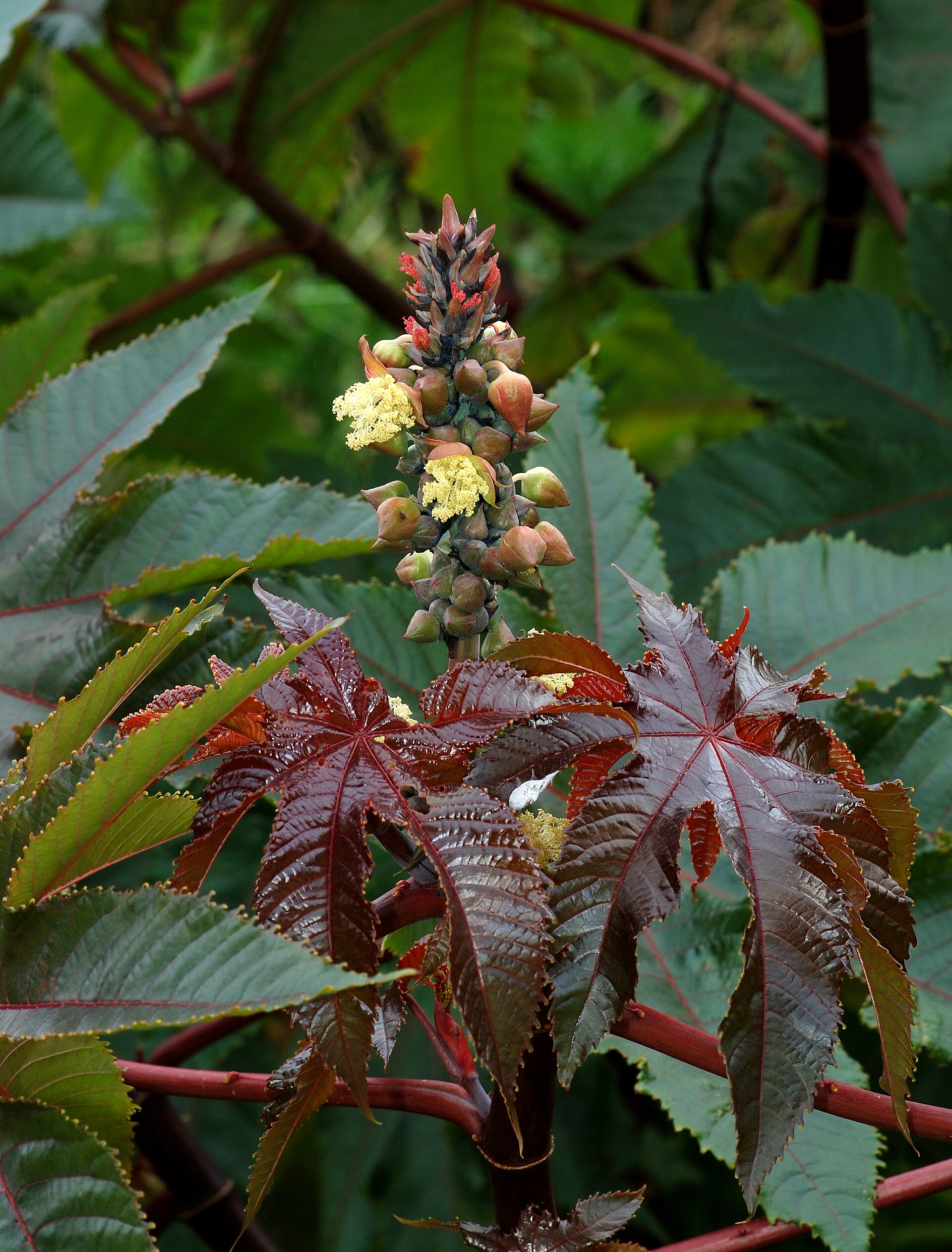
Traditionally used
⚠ The raw seed is poisonous — it holds ricin, a potent toxin, and chewing or swallowing castor seeds can be a medical emergency, especially for a child. The medicine is the oil, not the seed: ricin sits in the solid parts of the seed and stays behind in the mash, so a properly made oil does not carry it. Across Haiti and the Caribbean, lwil maskriti has been made at home for generations — the beans dried, roasted, ground to a paste, then boiled in water until the dark oil rises and is skimmed off the top. That oil is a long-standing remedy for the hair and scalp — growth, shine, dryness — and for the skin and aching joints. As an internal purgative it is powerful and old, not for casual or unguided use.
Prepared as
The oil, never the raw seed. Traditionally, lwil maskriti is made at home: the beans are dried, roasted, and ground to a paste, then boiled in water until the dark oil rises and can be skimmed off the top. The finished oil is massaged into the hair and scalp, or onto the skin and sore joints. Castor seeds are poisonous if eaten; anyone who has swallowed them should contact poison control or seek emergency care immediately.
In three languages
Kreyòl — ⚠ Grenn kri a se pwazon — li gen risin, yon toksin ki danjere anpil, epi moulen oswa vale grenn maskriti ka yon ijans medikal, sitou pou yon timoun. Se luil la ki se renmèd la, pa grenn nan: risin rete nan pati di grenn nan epi li pa pase nan luil la, kidonk yon luil ki byen prepare pa pote l. Atravè Ayiti ak Karayib la, lwil maskriti fèt lakay depi plizyè jenerasyon — grenn yo seche, woti, kraze fè yon pat, answit bouyi nan dlo jiskaske luil fonse a monte epi yo kimen l sou anwo a. Luil sa a se yon renmèd ki la depi lontan pou cheve ak po tèt — pouse, klere, sechrès — epi pou po a ak jwenti ki fè mal. Kòm yon pèjatif pou bwè li pisan epi li ansyen, li pa pou itilize san atansyon oswa san konsèy.
Français — ⚠ La graine crue est toxique — elle contient de la ricine, une toxine puissante, et mâcher ou avaler des graines de ricin peut constituer une urgence médicale, surtout pour un enfant. C'est l'huile qui est le remède, pas la graine : la ricine reste dans les parties solides de la graine et ne passe pas dans l'huile, de sorte qu'une huile correctement préparée n'en contient pas. À travers Haïti et la Caraïbe, le lwil maskriti se fabrique à la maison depuis des générations — les graines séchées, grillées, broyées en pâte, puis bouillies dans l'eau jusqu'à ce que l'huile foncée remonte et soit écumée. Cette huile est un remède de longue date pour les cheveux et le cuir chevelu — pousse, brillance, sécheresse — et pour la peau et les articulations douloureuses. Comme purgatif interne, elle est puissante et ancienne, à ne pas utiliser à la légère ni sans conseil.
Safety
Safety notes for this plant are still being written. Until they are, treat it with a cautious hand.
Plants can look similar and be misidentified — always verify with a local herbalist or guide before use.
Kept alongside